
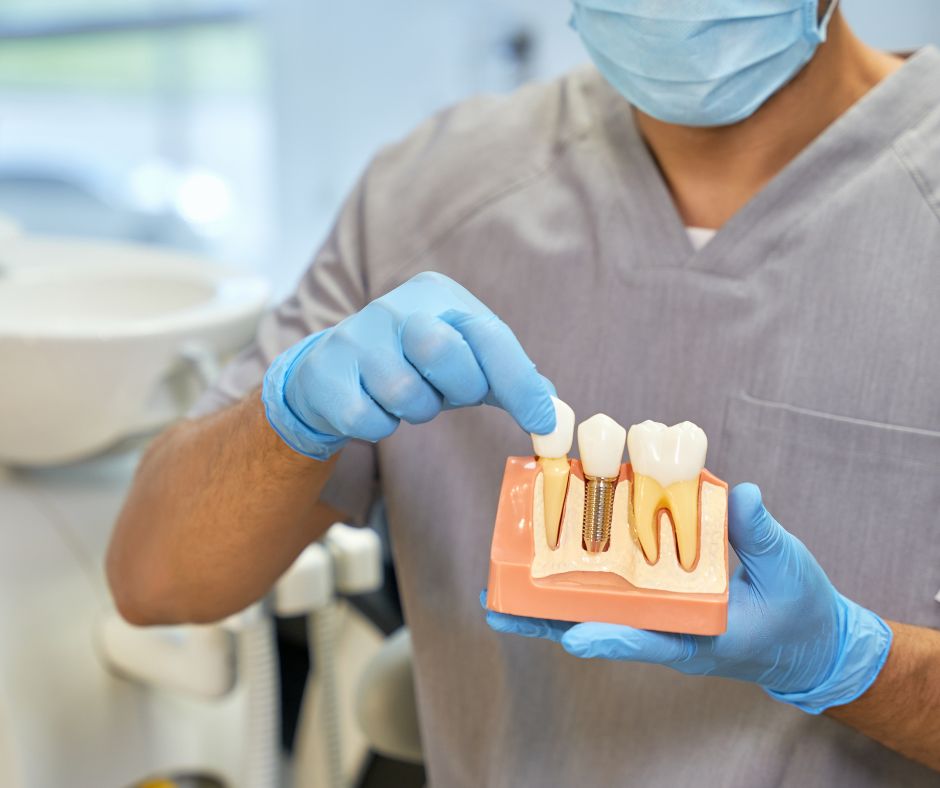
If you have spent years fighting with loose dentures or watching your teeth break down one by one, a permanent fix can feel out of reach. It does not have to be. All-on-4 dental implants replace a full arch of teeth with just four posts set into your jawbone. Most healthy adults with major tooth loss qualify, even those who have lost bone over time. Many patients walk out the same day with a fixed set of teeth in place.
At Torrey Hills Dental in Carmel Valley, San Diego, Dr. Brian Tasto, DDS brings focused training in implants and oral surgery from the University of the Pacific. Dr. Tasto checks each patient’s bone, health, and goals before making a plan.
Key takeaways if you are weighing All-on-4
- All-on-4 uses four implants per arch and can replace a full set of upper or lower teeth in one visit.
- A study in the Journal of the American Dental Association found a 99.2% prosthesis survival rate at 10 years.
- You may still qualify even with bone loss, because the rear implants tilt at an angle to grip denser bone near the front of your jaw.
- Conditions like poorly managed diabetes or heavy smoking can slow healing, but they do not rule you out on their own.
- Call Torrey Hills Dental at 858-523-1330 to set up a candidacy check with Dr. Tasto.
What All-on-4 implants replace and how they work
All-on-4 replaces every tooth in one arch, upper or lower, with a single fixed bridge locked onto four implants. Two implants go straight into the front of the jaw. The other two tilt at roughly 30 to 45 degrees toward the back. That tilt lets the rear posts reach denser bone near the front of your jaw, which often removes the need for a bone graft.
The bridge holds 10 to 14 teeth and screws onto the implants. It does not press on your gums, does not need glue, and does not come out at night. Your dentist removes it only at checkup visits for a deep clean underneath.
The two parts of the system age at different speeds. The titanium posts fuse with your bone through a process called osseointegration and can last for decades. The bridge, made from acrylic, zirconia, or porcelain blends, may need a remake after 10 to 15 years of daily use. Knowing this upfront helps you plan.
Who qualifies for All-on-4 implants?
Good candidates are adults who have lost most or all teeth in one arch, or whose remaining teeth are too damaged to keep. You do not need to be missing every single tooth. Many patients still have several teeth that the dentist removes during the same visit as implant placement.
Three factors decide whether you qualify: the scope of tooth loss, the shape of your jawbone, and your overall health.
Major tooth loss is the starting point. All-on-4 was built for people who need a full-arch fix, not a single crown or bridge. If six or more teeth in one arch are gone, cracked, loose, or badly decayed, this treatment may fit.
Your jawbone needs enough height and width to hold four posts. A minimum height of about 10 millimeters and a width of roughly 5 millimeters at each implant site is a common benchmark. Your dentist measures these with 3D scans before making any calls.
Gums must be free of active infection too. If you have gum disease, it has to be treated first. Torrey Hills Dental offers gum treatment to help patients reach that stage.
Does bone loss rule you out?
Bone loss alone does not bar most people from All-on-4. That is a big part of why this method exists. Older implant approaches need a post for every missing tooth and thick bone at each site. All-on-4 drops the post count to four and tilts the rear two to grab the naturally denser bone near the front of the jaw.
A 2014 review in Clinical Implant Dentistry and Related Research looked at outcomes across multiple studies. It found implant survival rates of 98% at five years and 95% at ten years, even in patients with reduced bone. The angled placement makes grafting unnecessary for many patients who would otherwise need it.
Some patients do still need grafting. If your bone loss is severe, a sinus lift or ridge buildup may be needed before implant day. Your dentist spots this on the scans, not in the chair.
If another dentist told you that you lack enough bone for implants, All-on-4 may still be an option. A full set of 3D scans and a hands-on exam is the only way to know.
Health factors that affect your candidacy
Most healthy adults qualify for All-on-4. A few conditions need closer review, and your dentist will go through your full health history at the consult.
Poorly managed diabetes slows healing and raises infection risk at the surgical sites. If your blood sugar levels stay in a stable range, diabetes alone does not rule you out. Your dentist may check with your doctor to confirm your levels before booking surgery.
Smoking cuts blood flow to gum tissue and bone. Studies link smoking to higher implant failure rates across the board. Most dental teams ask patients to quit at least two to four weeks before the procedure and to stay smoke-free through the healing window. This is not a suggestion. It directly affects whether the posts bond with your bone.
Some drugs matter too. Bisphosphonates, often given for bone-thinning conditions, can slow bone healing. Blood thinners may raise bleeding risk during surgery. Conditions like lupus or rheumatoid arthritis do not end the conversation, but they change the plan.
Age is not a barrier. Patients in their 70s and 80s get All-on-4 implants regularly, as long as their health supports surgery and healing.
What happens at an All-on-4 consult?
The consult tells you whether you qualify and how long the process will take. Plan for about 60 to 90 minutes.
Your dentist starts with a clinical check of your mouth, gums, and any remaining teeth. Next comes 3D imaging, usually a cone beam CT scan, which maps your jawbone’s height, width, and density at each possible implant site.
With those scans in hand, your dentist plans the exact spot and angle for each implant. The plan also flags whether you need any prep work first, such as pulls, gum treatment, or grafting.
You will talk through the type of bridge, the materials, the timeline for temporary and permanent teeth, and the cost. In most cases, a temporary bridge goes on the day of surgery. A permanent bridge follows three to six months later, once the implants have fully fused with the bone.
Bring your questions. Healing time, diet limits, sedation choices, and upkeep are all fair game. There are no bad questions when you are weighing a surgical procedure.
How long do All-on-4 implants last?
The titanium posts can last a lifetime when cared for properly. They lock into your jawbone and serve as roots for the bridge above. A long-term study in the Journal of the American Dental Association tracked All-on-4 patients for up to 10 years and found a 99.2% prosthesis survival rate.
The bridge itself, the visible teeth, usually lasts 10 to 15 years before it needs a refit or a full remake. Zirconia bridges tend to hold up longer than acrylic ones. Daily wear, bite force, and your cleaning habits all play a role.
Taking care of All-on-4 implants takes the same effort as caring for real teeth. Brush twice a day, use a water flosser or small brush to clean under the bridge, and keep your checkup visits on schedule. Your dentist removes the bridge now and then to clean the posts and check for bone changes.
Skipping upkeep is the fastest way to shorten the life of your implants. An infection called peri-implantitis can eat away at the bone around the posts and lead to failure if it goes untreated.
All-on-4 candidacy checks in Carmel Valley, San Diego
If loose dentures, failing teeth, or gaps in your smile have held you back, an All-on-4 evaluation can show you whether a lasting fix is in reach. The process starts with imaging, a hands-on exam, and a clear conversation about what will work for you.
At Torrey Hills Dental, Dr. Brian Tasto, DDS and Dr. James Tasto, DDS help patients across Carmel Valley, San Diego find the right path to full-arch restoration. Both doctors have earned Top Dentist honors from San Diego Magazine through its annual peer-selected survey.
The office is open Monday through Thursday, 8:00 AM to 5:00 PM, at 4765 Carmel Mountain Rd, Suite 101, San Diego, CA 92130. Call 858-523-1330 or request a consult through the Torrey Hills Dental patient portal to book your evaluation.