
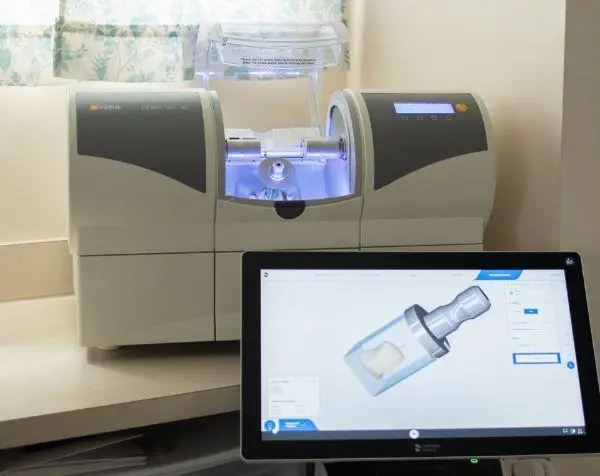
You cracked a molar, and now you need a crown. Your first question is usually simple. How many trips to the dentist will this take?
That answer splits into two paths. Your dentist designs, mills, and bonds a CEREC same-day crown in one visit, often in about two hours. A traditional crown uses a putty impression, a lab, and a temporary crown while you wait two to three weeks.
Both restore the tooth well. The real difference is time, comfort, and material range, not quality.
At Torrey Hills Dental in Carmel Valley, Dr. Brian Tasto, DDS is CEREC-trained and mills same-day crowns in the office. That means many patients skip the second appointment entirely.
Key takeaways if you need a crown
- A CEREC crown is done in one visit, usually about two hours, with no temporary crown.
- A traditional crown takes two visits over two to three weeks while a lab builds it.
- Both last a long time. Studies in the Journal of the American Dental Association put CEREC survival near 97 percent at five years and about 90 percent at ten.
- Traditional crowns offer a wider material range, which matters for some complex or front-tooth cases.
- Ask our Carmel Valley office whether your tooth is a good fit for same-day milling before you book.
What is a CEREC same-day crown?
A CEREC crown is a ceramic crown that your dentist designs and mills in the office during a single visit. CEREC stands for Chairside Economical Restoration of Esthetic Ceramics. A digital scanner captures your tooth, software designs the crown, and an in-office mill carves it from a ceramic block. You leave the same day with the permanent crown bonded in place.
The visit runs about two hours from start to finish. Your dentist numbs the tooth and shapes it, the same as with any crown. Then a digital wand scans the tooth instead of a putty tray.
The milling itself takes roughly 10 to 20 minutes. After that, your dentist polishes, stains, and bonds the crown.
Dr. Brian Tasto is trained on the CEREC system and performs this milling at our Carmel Valley office. Same-day treatment is one reason patients pick this route.
The traditional crown process, step by step
A traditional crown is a crown built by an outside dental lab over two to three weeks, across two appointments. Your dentist prepares the tooth, takes a physical impression, and places a temporary crown. The lab fabricates the permanent crown. You return for a second visit to have it fitted and cemented.
The first visit covers numbing, shaping, and the impression. Many people find the putty tray uncomfortable, and it can trigger a gag reflex. You then wear a temporary crown for a couple of weeks. That temporary can feel bulky or loosen before the real crown arrives.
The second visit is shorter. Your dentist removes the temporary, checks the fit and bite, adjusts if needed, and cements the permanent crown. The long timeline is the trade-off for using an outside lab.
Does one last longer than the other?
Both crown types last a long time, and the research does not favor one over the other. A review in the Journal of the American Dental Association reported CEREC restoration survival around 97 percent at five years and near 90 percent at ten. A 10-year study of Cerec restorations found survival of about 94.7 percent at five years and 85.7 percent at ten. Traditional lab crowns fall in the same range.
What actually drives crown lifespan is not the fabrication method. It is your bite force, your daily brushing and flossing, and whether you grind your teeth. Grinding is the quiet killer of any crown. A crown protects the tooth, but it still needs the same care as a natural tooth.
The American Dental Association notes that ceramic crowns hold up well against normal biting and chewing. Regular checkups catch small problems before they crack a crown.
Do CEREC and traditional crowns look the same?
Both can look natural, and the result depends more on the dentist than the method. CEREC crowns are milled from high-quality ceramic blocks, then stained and glazed to match your nearby teeth. Traditional labs can hand-layer porcelain, which gives a master ceramist more room to fine-tune shade on tricky front-tooth cases.
For a back molar, most patients cannot tell the difference. The tooth is not visible when you smile, and a milled ceramic crown matches fine. Speed usually wins here.
For a highly visible front tooth with unusual shading, a lab crown may earn its extra weeks. This is worth discussing with your dentist. If your case calls for custom layering, our team will tell you honestly.
Your crown options, side by side
Here is how the two approaches compare on the factors patients ask about most.
| Factor | CEREC Same-Day Crown | Traditional Crown |
| Number of visits | 1 | 2, sometimes 3 |
| Total time | About 2 hours | 2 to 3 weeks |
| Temporary crown | Not needed | Worn for weeks |
| Impression | Digital scan | Putty tray |
| Where it is made | In our office | Outside lab |
| Material range | Ceramic blocks | Wider, including layered porcelain |
| Best for | Most single crowns, busy schedules | Complex or front-tooth shade cases |
The table shows why so many patients choose same-day treatment for a routine molar. The traditional route holds its place for cases that need a wider material choice.
What does a crown cost, and does insurance cover it?
Same-day and traditional crowns usually cost about the same, and most dental plans treat them the same way. Traditional crown pricing includes an outside lab fee. CEREC pricing covers the in-office scanner and mill instead. The patient price often lands in a similar range either way.
Most dental insurance plans cover crowns at roughly half the cost after your deductible, whether the crown is milled same-day or built in a lab. A few plans have clauses about alternative procedures, so check your specific coverage.
We can give you an exact price and check your benefits before you commit. Call our Carmel Valley office and we will walk through the numbers for your tooth.
How to choose the right crown in Carmel Valley
The right crown comes down to your tooth, your timeline, and the material your case needs. Same-day CEREC works well for most single crowns and for anyone who cannot easily fit two visits into a busy week. A traditional lab crown suits complex cases or a front tooth that needs custom shade work.
You do not have to figure this out alone. Dr. Brian Tasto, DDS is CEREC-trained and will look at your tooth, explain which option fits, and give you a clear cost before anything starts. Torrey Hills Dental accepts patients age 5 and up, so families can plan care in one place.
If you have been putting off a crown because you dreaded multiple visits, same-day treatment may change the math. Call Torrey Hills Dental in Carmel Valley at 858-523-1330 to ask whether your tooth is a good fit for a same-day crown, or request a consultation online.